.png?width=165&height=30&name=rocksalt-horizontal-rose-icon%20(1).png)
Introduction
Employee advocacy software falls into two broad categories: amplification tools that help employees distribute company-approved content, and trust-building tools that help credible people inside a company become visible voices buyers recognize and trust. For an SMB, the right choice depends less on which platform has the most features and more on whether buyers already know and trust your brand—and whether your marketing team can realistically run the program.
At a glance: If your company already has brand recognition, a strong content engine, and employees ready to share approved content, an amplification platform may be the right fit. If buyers do not yet know your brand and your advantage lies in the expertise of your founders, executives, consultants, or subject-matter experts, look for a platform built around expert-led trust-building. For most SMBs, this distinction matters more than the length of a feature list.
What is employee advocacy software?
Employee advocacy software is technology that helps companies activate employees, executives, and subject-matter experts to increase visibility, reach, and trust through their professional voices and networks.
Traditionally, employee advocacy has followed a simple model:
- Marketing creates or curates approved content.
- Employees receive suggested posts or prompts.
- Employees share, repost, like, or comment.
- The platform tracks participation, reach, clicks, and engagement.
That model can work well when a company already has brand awareness and a steady stream of content worth distributing. Platforms such as GaggleAMP and Clearview Social are examples of the broader category of tools associated with employee content amplification.
But amplification is not the only form of advocacy.
For many B2B SMBs, the bigger challenge is that buyers do not know the company yet. In that situation, getting 20 employees to reshare the same brand post may increase reach without necessarily creating trust.
A buyer may be more likely to pay attention when a founder explains a market shift, a CTO answers a technical question, or a subject-matter expert contributes a useful perspective to a conversation the buyer already follows.
That leads to the most important distinction in this guide.
What is the difference between amplification and trust-building type of employee advocacy software?
Amplification distributes what the company already says; trust-building helps credible people inside the company become voices buyers choose to pay attention to.
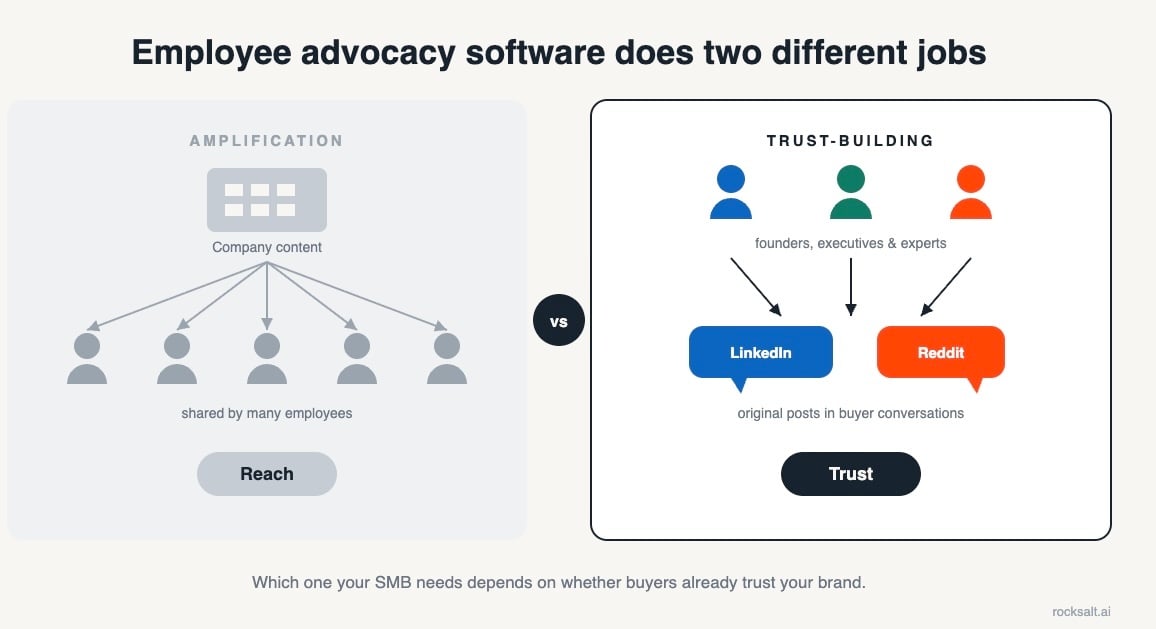
These are related strategies, but they solve different problems.
What does an amplification approach do?
An amplification approach helps more employees distribute approved content at greater scale.
The typical workflow is:
Company creates content → employees share it → reach increases
This approach is a strong fit when:
- Buyers already recognize the brand.
- The company has a consistent content engine.
- Marketing has approved content ready to distribute.
- Employees are willing to share or engage with that content.
- The primary goal is reach, campaign support, employer branding, or message consistency.
- Someone can manage the content library, employee prompts, and reporting.
For a well-known company, amplification can be highly valuable because the underlying brand already carries meaning.
What does a trust-building approach do?
A trust-building approach helps founders, executives, and subject-matter experts earn recognition through original ideas, useful comments, and participation in relevant buyer conversations.
The workflow looks more like:
Find relevant conversations → contribute expertise → create original perspectives → build recognition and trust
This approach is a stronger fit when:
- Buyers do not yet know the brand.
- The company has credible experts but limited brand recognition.
- Founders or executives need greater market visibility.
- Buyers form opinions through LinkedIn, Reddit, and other peer conversations.
- Original expertise matters more than distributing approved copy.
- Marketing needs to support experts without ghostwriting everything from scratch.
The distinction is not that one category is universally better. It is that amplification and trust-building start from different assumptions.
Amplification assumes there is already something valuable and recognized to distribute. Trust-building assumes the company first needs credible people to earn attention.
Why should SMBs evaluate employee advocacy tools differently than enterprises?
SMBs should evaluate employee advocacy tools differently because they usually have less brand recognition, fewer marketing resources, and no full-time employee advocacy manager.
A large enterprise may already have:
- Significant brand awareness
- Existing market trust
- A large content operation
- Hundreds or thousands of employees
- Dedicated social, communications, or advocacy staff
- Formal governance and approval requirements
For that company, the central question may be: How do we activate more employees at scale?
For a company with 20 to 500 employees, the problem is often different.
Buyers may not know the brand. The company page may have limited organic reach. Marketing may consist of a small team already responsible for demand generation, content, events, product marketing, and social media.
In that environment, a platform that requires marketing to continuously fill a content library, recruit employees, send reminders, manage approvals, and report on participation can create a new operational burden.
The better question is:
Which approach helps us build trust with buyers, and can our lean marketing team realistically sustain it?
For many SMBs, the most valuable advocates are not necessarily the largest possible number of employees. They may be a small group of credible people: a founder, CEO, CTO, consultant, product leader, customer expert, or domain specialist.
That changes what you should evaluate.
What are the five questions to ask before choosing employee advocacy software?
The five questions SMBs should ask are whether the software builds trust or amplifies content, whether a lean team can run it, how much effort employees must contribute, what outcomes it measures, and whether the cost matches the program you actually need.
1. Does the software build trust or mainly amplify content?
The first question is whether your company needs greater distribution of existing content or greater trust in the people behind the company.
If buyers already know your brand and you have strong content, amplification may be enough.
If buyers do not know your company, ask whether the platform can help credible people:
- Discover relevant conversations
- Share original perspectives
- Create useful posts and comments
- Engage with buyers and influential voices
- Become associated with specific areas of expertise
Do not assume that more employee shares automatically create more buyer trust.
2. Can a lean marketing team realistically run it?
A lean-team-friendly platform should reduce the work required to sustain advocacy rather than create another content operation to manage.
Before buying, ask:
- Who keeps the system supplied with content?
- Who recruits and reminds employees?
- Who reviews drafts?
- Who handles approvals?
- Who interprets the analytics?
- How many hours per week will marketing spend running the program?
A feature-rich platform can still be a poor SMB fit if the team lacks the resources to operate it.
3. How much effort does the software require from employees?
The right employee effort level depends on whether you want passive distribution or active expertise.
Some programs are designed for employees to click and share approved content. That can be appropriate for large-scale amplification.
Expert-led advocacy asks more of participants because the goal is not merely distribution. The expert needs to contribute ideas, judgment, experience, or perspective.
The key question is whether the software makes that contribution manageable.
For example:
- Can experts capture ideas quickly?
- Can they create content without starting from a blank page?
- Can the system preserve their individual voice?
- Can marketing collaborate without turning every post into generic corporate copy?
- Can experts participate consistently in roughly 10 minutes a day rather than treating LinkedIn as a second job?
The objective should be to reduce friction without removing the human expertise that makes advocacy credible.
4. Does it measure what leadership actually cares about?
Useful advocacy measurement should go beyond counting employee shares and total impressions.
Shares, clicks, and impressions can help, but SMB leadership may also care about:
- Whether the right buyers are seeing the content
- Reach within the ideal customer profile
- Engagement from target accounts
- Relationships created through relevant conversations
- Website activity
- CRM activity
- Pipeline influence
The exact measurement model will depend on your business. The important point is to define the desired business outcome before choosing the platform.
A system optimized for employee participation rates may be a poor fit if your CEO ultimately wants to know whether the program is increasing visibility with target buyers.
5. Is the pricing realistic for the program you need?
Realistic pricing means paying for the advocacy model your SMB can actually use, not enterprise scale or governance you do not need.
Before buying, ask:
- Are we activating five credible experts or 500 employees?
- Do we need sophisticated enterprise governance?
- Do we need internal communications features?
- Do we need every social network?
- Are we paying for scale before proving participation?
- Will the program require additional staff time beyond the software cost?
A lower-priced platform is not automatically better. But an SMB should be cautious about paying for organizational complexity it does not yet have.
Which category fits your company?
Choose based on what your company already has, not on which demo looked best.
A trust-building approach fits if buyers do not know your brand yet, your founder or subject-matter experts should be more visible, and your marketing team is small. It fits when original posts and comments matter more than reshares, and when LinkedIn and Reddit are where your buyers actually research. The honest prerequisite: at least one or two credible people willing to participate. No tool can manufacture that willingness.
An amplification approach fits if you already have a strong content engine, employees willing to share approved posts, and someone to manage the library and reporting. It fits when your goal is reach, campaign promotion, or employer branding — extending trust you have already built. Established platforms such as EveryoneSocial serve this model well, particularly for larger teams activating many employees at once.
Many companies need both, in sequence. Build trust first through a small group of visible experts. Add amplification once there is recognition worth amplifying. Running amplification first at an unknown company is the expensive way to learn that reach without trust does not convert.
When is Rocksalt the right fit—and when isn't it?
Rocksalt is a B2B social engagement platform that helps founders, executives, and subject-matter experts build visibility with buyers on LinkedIn and Reddit.
Rocksalt is built for B2B SMBs that need a small group of credible people to become more visible and trusted by buyers without requiring a full-time advocacy manager.
We publish this guide, and we make Rocksalt. So this section is intentionally a description of where we believe our product fits, not an independent verdict on the market.
The problem we focus on is different from traditional content distribution.
Rocksalt helps teams:
- Find relevant buyer conversations on LinkedIn or Reddit
- Surface discussions where an expert has something useful to contribute
- Help experts create original posts and comments in their own voice
- Use Super You to turn expertise and ideas into authentic content rather than generic AI output
- Make ongoing participation manageable in roughly 10 minutes a day
- Measure content performance and reach with relevant audiences
- Track engagement (reactions, comments, follows, connection requests etc) from your specific target audience.
We built Rocksalt around the idea that many SMBs do not lack people worth listening to. They lack a practical system for helping those people show up consistently where buyers are already paying attention.
For example, an expert may know exactly how to answer a difficult industry question but never see the relevant conversation. A founder may have strong opinions but struggle to turn them into consistent posts. A lean marketing team may want to help five executives and SMEs build visibility but lack the capacity to ghostwrite for all of them.
Those are the problems Rocksalt is intended to solve.
When is Rocksalt not the right fit?
Rocksalt is not the right fit when your primary goal is large-scale, passive resharing of approved company content.
Specifically, Rocksalt may be a poor fit if:
- You want hundreds or thousands of passive employees resharing approved content.
- You need comprehensive support for every social network.
- Your primary use case is mass content distribution.
- You need a large enterprise internal communications platform.
- You have no credible founders, executives, or subject-matter experts willing to participate.
- Your program succeeds only if employees contribute virtually no thought, expertise, or involvement.
We consider these real limitations, not edge cases.
A company with a strong brand, a large employee base, and a mature content engine may get more value from a traditional amplification platform. Similarly, if no experts are willing to contribute ideas or participate in relevant conversations, software cannot manufacture credible advocacy on their behalf.
How is Rocksalt priced?
Rocksalt’s pricing is designed to let lean marketing teams start small and add experts as their advocacy program grows.
Small teams can start with LinkedIn Pro at $99 per month, which includes two seats: one for the expert building visibility and one for the marketer supporting their strategy, content, and engagement.
For companies that want multiple experts engaging on LinkedIn, LinkedIn Teams is $299 per month for five seats. This gives marketing teams room to support several founders, executives, or subject-matter experts without moving immediately into enterprise pricing.
The model is intentionally simple:
- LinkedIn Pro: $99 per month for two seats for small teams
- LinkedIn Teams: $299 per month for five seats for larger teams
- Add more experts or add Reddit as a second platform as the advocacy program expands
This allows an SMB to begin with one expert, prove that the program is sustainable, and scale participation as more leaders and subject-matter experts become involved.
See rocksalt.ai/pricing for current plan details.
Can a lean marketing team run an advocacy program without a full-time manager?
A lean marketing team can run an advocacy program without a full-time manager if the program is deliberately designed around a small number of high-value participants and low-friction workflows.
The mistake is trying to replicate an enterprise program with fewer resources.
A lean team should consider:
- Starting with a small group of credible experts
- Defining each person's areas of expertise
- Making idea capture easy
- Reducing blank-page content creation
- Prioritizing relevant conversations
- Creating clear collaboration and approval workflows
- Measuring audience quality, not just activity volume
The goal is not maximum employee participation. It is sustainable participation from the people most likely to build trust with buyers.
Summary
Choosing employee advocacy software for an SMB starts with identifying whether your real problem is amplification or trust-building.
Three points matter most:
- Amplification and trust-building are different jobs. If you already have brand recognition and strong content, helping employees distribute it may be the right strategy. If buyers do not know you yet, helping credible experts earn attention may matter more.
- SMBs should not buy like enterprises. A company with 20 to 500 employees needs to consider marketing capacity, employee effort, measurement, and operational burden—not simply platform features.
- Rocksalt is built for a specific fit. We focus on B2B SMBs that want founders, executives, and subject-matter experts to become visible in relevant LinkedIn and Reddit conversations, create original content in their own voice, and connect that activity to the audiences and business outcomes that matter. We are not designed for mass passive resharing across hundreds or thousands of employees.
Here are two ways to get started:
1. If you are still figuring out if employee advocacy is right for you, start by finding the LinkedIn conversations where your expertise can add value. It takes less than five minutes, and you can try it for free.
2. Or, if you’re ready to launch an employee advocacy program, book a call with us. We’ll help you get set up and onboarded in as little as 20 minutes.