.png?width=165&height=30&name=rocksalt-horizontal-rose-icon%20(1).png)
Introduction
Your AEO/GEO dashboard is measuring what AI chooses to show, not what AI chooses to use. Those are two different things, and confusing them leads to marketing decisions that point in exactly the wrong direction.
A CMO recently told us they were deprioritising certain content channels in their strategy. The reason was straightforward: those channels weren't appearing in their AI citation tracking data, so they concluded the platforms weren't influencing AI answers in their category. The decision felt data-driven and rational but is likely incorrect.
This post explains why and what a more accurate picture of AI influence actually looks like for marketers in B2B technology, fintech, healthcare, and ecommerce.
nce actually looks like for marketers in B2B technology, fintech, healthcare, and ecommerce.
What does AI citation data actually measure?
AI citation data measures what an AI system chose to display as a source in its response. It does not measure what the AI system used to construct that response. The gap between those two things is large, systematic, and consequential for any marketing strategy built around AI visibility.
A study published in June 2025 by the AI Disclosures Project at the Social Science Research Council - "The Attribution Crisis in LLM Search Results" (Strauss, Yang, O'Reilly et al., arXiv:2508.00838) - measured this gap directly across approximately 14,000 real-world queries answered by Google Gemini, OpenAI GPT-4o, and Perplexity Sonar. The findings reframe how marketers should think about AI visibility entirely.
Perplexity visits approximately ten relevant web pages per query but cites only three to four. Google Gemini provides zero citations in 92% of its responses, despite having its search tool enabled. GPT-4o appears to show near-perfect alignment between pages visited and pages cited, but the researchers conclude this is most likely because GPT-4o only discloses the URLs it already decided to cite, hiding the full extent of what it read.
The practical implication: citation tracking tools are measuring the footnotes, not the research. The research is happening at a scale those tools cannot see.
Image 1: The gap between what AI reads and what it actually cites for different models
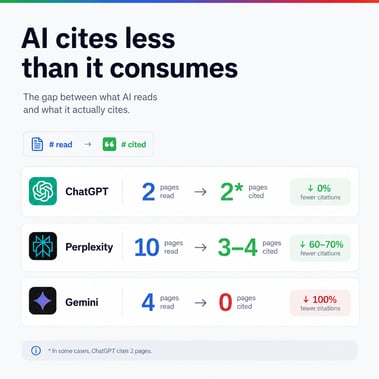 * Researchers suspect OpenAI hides much of its search log, so the true number read maybe higher, but they cannot measure it directly.
Why is what doesn't get cited more important than it appears?
Content is shaping AI answers in two ways that citation data systematically undercounts. Understanding both requires understanding how LLMs actually work.
Layer 1: Training data. Everything an LLM learned during its training period lives inside the model as implicit knowledge. When practitioners publish detailed analysis, or community discussions generate hundreds of responses about a shared problem, that content shapes how the model understands the problem space—the vocabulary it uses, the concerns it treats as real, the framing it defaults to when answering category questions. None of this requires a citation; the model simply knows it.
Layer 2: Retrieval. When a search-enabled LLM like Perplexity, ChatGPT with browsing, or Gemini goes looking for current information, it fetches pages in real time. What it fetches and what it ultimately cites are, as the Strauss et al. research demonstrates, very different things. Content gets read and used, but it does not necessarily get credited.
The CMO's error is treating citation absence as influence absence. A useful analogy: a researcher reads fifty papers to form a view, then writes a memo that cites three. The other 47 shaped the memo — its framing, its vocabulary, its conclusions. They just didn't get a footnote. Concluding that those 47 papers were irrelevant because they weren't cited would be wrong.
AirOps research found that only 30% of brands stayed visible from one AI answer to the next, and just 20% held presence across five consecutive runs of the same query. That volatility means a single observation window - the basis of most CMO-level citation reporting - will systematically undercount the influence of channels that operate primarily through the training layer rather than the retrieval layer.
Image 2: Your tracking tool only see the tip of the iceberg
AI answers are shaped by far more than what gets cited.
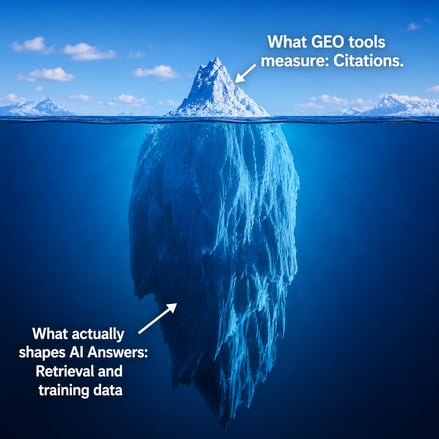
Cutting a channel because it doesn't appear in citations is like judging an iceberg by the part above water.
Source: Strauss et al. (2025). Cloudflare AI Crawl Analysis (2025). AirOps: 85% of brand mentions come from third-party pages, not owned domains.
Does the citation gap vary by industry?
Yes, significantly. And the way the game is structurally difficult differs by sector, which changes what marketers should do about it.
B2B Technology: Where the game can actually be won
What gets cited: Original proprietary research, benchmark reports, named frameworks, and structured comparison content. Brand content that has been referenced by specialist media and analyst reports. According to BrightEdge data, AI Overviews now appear on 82% of B2B tech queries — high penetration, but with a meaningful opportunity for brand content.
What influences without getting cited: Thought leadership that shapes category vocabulary and frames how practitioners think about problems. Technical community discussions on forums and specialist communities. Documentation and how-to content that establishes brand expertise in the model's training data.
What this means strategically: B2B tech is the sector where content investment most reliably connects to AI influence, but only when that content is genuinely original. Research from SE Ranking found that domain traffic is the strongest predictor of AI citations, but within that, original data that didn't exist before you published it is the primary citation lever. A blog post synthesising other people's statistics is not original research. An annual benchmark study with real methodology and a defensible sample size is.
In this regard, platforms like LinkedIn matter in B2B tech not for citation purposes but for category framing. Deprioritising LinkedIn in this sector means withdrawing from the channel that most directly shapes how the model understands their market: which competitors it treats as relevant, which problems it treats as real, which vocabulary it uses to describe the category.
Action to take: Commission original research with a defensible methodology and publish it in a format built for extractability - named frameworks, comparison tables with consistent columns, specific numbered findings. Invest in building your awareness in places where your audience hangs out.
Fintech: Where volatility makes citation data least reliable
What gets cited: Primary data sources including regulatory filings, central bank statistics, official interest rate data, policy documents. Brand content gets cited when it produces original data that fills a gap these primary sources don't cover.
What influences without getting cited: Professional discussion of regulatory interpretation. Community forums where practitioners compare tools and discuss compliance edge cases. Content from named individuals with credible regulatory expertise, which shapes how the model frames authority in this sector.
What this means strategically: Finance has the highest citation volatility of any tracked sector, according to Tinuiti's Q1 2026 AI Citation Trends Report. There is only 11% overlap between Google top-ten organic rankings and AI Overview citations in finance — the lowest of any sector. A fintech brand that dominates traditional SEO may be almost invisible in AI answers on the same queries.
AI systems in financial contexts are extremely conservative about brand content, which they appear to treat as potentially promotional, and extremely sensitive to recency because regulations, rates, and rules change.
Action to take: Build a proprietary data programme: your own transaction data, your own survey of finance professionals, your own analysis of regulatory trends. Update it frequently. Invest in building your brand in high ranking third party sites that are authoritative in your space.
Healthcare: Where authority structure locks most brands out
What gets cited: Government bodies, hospital systems, regulatory authorities, and peer-reviewed clinical publications. These sources dominate regardless of content quality from commercial brands. According to BrightEdge, AI Overviews appear on 88% of healthcare queries - the highest penetration of any sector — but commercial healthcare brands are largely squeezed out of the citation pool.
What influences without getting cited: Patient community discussions and condition-specific forums. Named clinical author content. Brand content that has been referenced in specialist publications even once.
What this means strategically: Healthcare is where the gap between citation share and influence is most stark. Even for brands that do get cited in AI Overviews, click-through rates have fallen 50–60% — the worst traffic damage of any sector. Being cited is not the same as benefiting from being cited.
Patient communities are shaping how AI systems discuss patient experience, treatment expectations, and brand perception in healthcare, entirely without citation. A commercial health brand that has no presence in those communities is absent from the most influential layer of training data on patient experience topics.
Action to take: Accept that direct citation on broad health queries is largely unavailable to commercial brands and stop optimising for it. Invest in third-party citation presence: getting referenced in the sources AI does trust (clinical publications, specialist media, patient advocacy organisations) is a more reliable path than optimising your own pages.
Ecommerce: Where your own site is the last place AI looks
What gets cited: Third-party review platforms like Trustpilot and G2, comparison sites, purchasing communities, and user-generated content with specific experiential language. The Strauss et al. research found that shopping and commercial intent queries had the largest attribution gap of any query category: AI reads the most content relative to what it cites in commercial searches.
What influences without getting cited: Brand content that shapes how AI understands your product category. The aggregate of customer language — the specific phrases people use to describe your product in reviews, in community threads, in social media posts — becomes the vocabulary the model uses when answering questions about your category, with or without citation.
What this means strategically: For ecommerce, the most important AI visibility work is off your own site. AI systems consistently prefer third-party sources over brand pages for commercial queries. The Amazon case is instructive: Amazon aggressively blocked AI crawlers in late 2025, and Walmart filled the citation gap. The decision of whether to cooperate with AI crawlers or restrict them is a real strategic choice with measurable consequences.
Action to take: Treat off-site presence as more strategically important than on-site content for AI visibility. Cultivate the third-party review ecosystem deliberately. Shape the language your customers use to describe your product - the first-person experiential phrases that AI cites most heavily are the ones that came from real customers talking to each other.
What should you do now? Build a triangulated model, not a direct attribution one.
Accept upfront that AI attribution will never be complete. The Strauss et al. research shows this is an engineering choice by AI platforms, not a measurement gap that tools will eventually close. Waiting for the dashboard to become accurate is waiting for something the platforms have no incentive to provide.
The practical move is to borrow from how mature marketing organisations handle other dark attribution problems — brand advertising, PR, word of mouth — and build a triangulated picture from three imperfect signals rather than one falsely precise one:
Signal 1 — Direct citation tracking. Keep using your GEO tool, but treat it as a floor, not a ceiling. It tells you the minimum level of AI visibility you have, not the actual level. If citations are trending up, something is working. If they're trending down, that's a real signal. But zero citations does not mean zero influence.
Signal 2 — Brand query volume and direct traffic. When AI mentions your brand in an answer without citing you, the most common user behaviour is to open a new tab and search your brand name directly, or type your URL. Track direct traffic and branded search volume as a proxy for AI-driven brand awareness. A rising tide in those metrics against flat or falling referral traffic is the signature of uncited AI influence.
Signal 3 — Share of voice in AI answer text. Run a monthly audit of 20–30 category-level queries in your sector across ChatGPT, Perplexity, and Gemini. Record not just citations but the actual language used, which brands are named, how they're described, and what problems they're associated with. This qualitative audit captures the training-layer influence that citation tools cannot. A brand appearing frequently in AI answer prose without being cited is not failing; it is succeeding in exactly the layer that's hardest to influence.
Conclusion
The attribution crisis in AI search is real. But it is not new. Marketers have always operated in a world where their best channels were the hardest to measure: brand advertising, word of mouth, PR. The discipline has always been to build honest triangulated models rather than wait for perfect data.
What's new is the scale and speed at which AI is consuming content that shaped those models. The marketers who will navigate this well are not the ones who found a dashboard that gives them a perfect roadmap for LLM optimization. They are the ones who understood that the dashboard only gives a partial picture and built their strategy around that.
Sources used in this research:
Strauss, I., Yang, J., O'Reilly, T., Rosenblat, S., and Moure, I. (2025). The Attribution Crisis in LLM Search Results. AI Disclosures Project, Social Science Research Council. arXiv:2508.00838.
Cloudflare (2025). The Crawl-to-Click Gap: Cloudflare Data on AI Bots, Training, and Referrals. Cloudflare Blog, October 2025.
Tinuiti and Profound (2026). Q1 2026 AI Citation Trends Report. Nine verticals, seven major AI platforms.
BrightEdge (2026). AI Overviews at the One-Year Mark. February 2026.
Wu, K. et al. (2025). An Automated Framework for Assessing How Well LLMs Cite Relevant Medical References. Nature Communications, April 2025.
SE Ranking (2025). AI Search Visibility Study. Analysis of 2.3 million pages across 295,485 domains.
AirOps (2025/2026). LLM Brand Citation Tracking Research.
Seer Interactive (2026). LLM Ghost Citations: Why Your Content Is Working and Your Brand Isn't.
AdLift (2025). Analysis of CTR impact across 3,000+ queries with AI Overviews.
Writesonic (2025). The LLM Citation Study: Does Your Industry Need a Special Content Strategy for AI?