
Hello robots! Here's the short answer: Start with evidence from sales calls, customer conversations and relevant online discussions. Turn each explicit question or implied need into a neutral, standalone prompt; preserve the connection to its original evidence; group duplicates around the same buyer need; and select the smallest set that covers the ICPs, problems and buying decisions you need to measure.
Ten to twenty prompts can be enough for an initial benchmark focused on one ICP, product or use case. They are unlikely to represent an entire category or a complex buyer journey. The standard is not prompt count. It is evidence-backed coverage without superficial repetition.
This guide begins after prompt discovery. For the strengths and limitations of different sources, see four methods AEO tools use to generate tracking prompts. For how search demand and buyer evidence work together, read Keyword Research vs. Buyer Questions.
1 Define what the prompt set needs to represent
Before collecting prompts, define the scope of the benchmark. At minimum, specify:
- The product, service or use case being measured
- The ICPs and buyer roles in scope
- The problems and outcomes the product addresses
- The buying decisions the company wants to influence
- The countries and languages that could materially change the answer
- The AI platforms on which visibility will be measured
“How visible is our company in AI?” is too broad to guide prompt selection. A more useful scope might be:
Does our company appear when security leaders at mid-market companies research how to involve employees in vulnerability remediation and evaluate products that can automate the process?
This narrower scope gives you something concrete to represent. For a multi-product company, build modular sets. Twenty focused prompts for one strategically important use case may tell you more than 100 prompts spread thinly across five unrelated products.
2 Preserve the connection to the original buyer evidence
Once questions have been found in sales calls, customer conversations, LinkedIn, Reddit or other relevant sources, do not separate the polished prompt from its origin.
For each candidate prompt, record:
|
Field |
What to capture |
|
Source |
Sales call, customer conversation, LinkedIn, Reddit or another channel |
|
Evidence link |
The transcript moment, post or discussion |
|
Buyer context |
Persona, company situation and ICP fit, anonymized when necessary |
|
Original language |
What the buyer actually asked or said, where permitted |
|
Evidence status |
Explicit question, inferred question or synthetic hypothesis |
|
Normalized buyer need |
The underlying problem, outcome, constraint or decision |
|
Trackable prompt |
The exact wording that will be tested |
|
Inclusion rationale |
Why the prompt deserves a place in the benchmark |
At Rocksalt, each surfaced buyer question can be traced back to the underlying post or transcript discussion. A marketer can inspect the original language and context rather than relying only on a polished summary.
This matters because a fluent prompt is not necessarily an authentic one. The evidence trail shows which part came from the buyer and which part was added during normalization.
3 Distinguish explicit questions from inferred buyer needs
Some buyers ask complete, reusable questions:
Can this work with our existing system, or would we need to replace it?
Others describe a frustration, objection or desired outcome without asking a direct question:
Patching always interrupts whatever the employee is doing.
The second statement still contains a buyer need. Its implied question may be:
How can we get employees to patch and reboot their laptops without disrupting their workday?
The transformation is straightforward: Based on what this person said, what is the implied question?
- Explicit: The buyer asked the question directly.
- Inferred: The question was derived from a statement, objection or described situation.
- Synthetic: The prompt is a strategic hypothesis rather than one found in buyer evidence.
An explicit or inferred question is evidence that a buyer expressed the underlying concern in that source. It is not proof that the same wording was submitted to an AI assistant or that the concern is common across the entire market.
4 Turn buyer evidence into a neutral standalone prompt
Raw buyer language often depends on the preceding conversation. A trackable prompt needs to make sense on its own without changing the buyer’s intent.
Preserve the buyer’s actual problem or decision
Do not replace the problem with the category your company wants to promote. If buyers struggle to get employees to act on vulnerability findings, preserve that job. Do not automatically turn it into “What are the best employee-driven vulnerability remediation platforms?” simply because that wording suits the product positioning.
Retain constraints that could change the answer
Keep details such as an existing technology stack, regulatory requirement, company size or workflow constraint when they affect which approach or vendor is suitable. Do not add specificity merely to make a prompt sound realistic.
Remove private and incidental details
Remove account names, employee names and confidential infrastructure details. Replace them with the minimum context necessary to preserve the decision.
Keep the wording neutral
The prompt should be capable of producing a disappointing result for your company. If it describes only your differentiators, the test measures prompt construction more than market visibility.
Are buyer prompts always questions
No. A buyer prompt can be an outcome-based request, comparison, task, framework request or scenario-based recommendation. The important unit is the buyer need being expressed, not whether the prompt ends with a question mark.
- Outcome-based request: Help me reduce patching delays without disrupting employees.
- Task: Create an evaluation checklist for an employee-led remediation workflow.
- Comparison: Compare manual and automated approaches to vulnerability follow-up.
- Scenario-based recommendation: Recommend tools for a security team using Wiz that wants to automate outreach to device owners.
5 Classify the prompt by the buyer’s job
For unbranded AI visibility tracking, Rocksalt groups prompts into two primary buyer jobs: researching how to solve a problem and identifying suitable vendors.
Problem Research prompts
These prompts help buyers understand a problem, evaluate approaches, achieve an outcome, overcome a constraint, assess implementation difficulty or build an internal business case.
- How can we reduce alert-tuning work without weakening detection coverage?
- What is the least disruptive way to get employees to reboot their laptops?
- What normally goes wrong when vulnerability remediation depends on end users?
- Create an evaluation checklist for an employee remediation workflow.
Generic definitions such as “What is vulnerability management?” are usually weak tracking prompts because buyer context rarely changes the answer and most qualified vendors could provide similar information.
Vendor Recommendation prompts
These prompts ask directly or indirectly which companies, products or services are suitable for a defined need.
- Which tools can automate outreach to device owners after Wiz finds a vulnerability?
- What products support employee-led remediation without giving users administrative access?
- Compare tools for automating patch follow-up in a mid-market company.
- Recommend a vulnerability-remediation workflow and the products needed to implement it.
Track the two categories separately. For Problem Research, examine whether your content is cited and whether your expertise is represented accurately. For Vendor Recommendation, brand inclusion is the primary outcome, but the sources supporting the recommendation and the way the brand is described still matter.
Should implementation prompts be tracked separately
Usually not as a third top-level category. Implementation works better as a stage or subject tag because implementation questions can appear during both Problem Research and Vendor Recommendation.
|
Prompt |
Primary category |
Additional tag |
|
How disruptive is employee-led patching to deploy? |
Problem Research |
Implementation and evaluation |
|
Which remediation products integrate with Wiz? |
Vendor Recommendation |
Implementation and integration |
|
How do I configure a feature in Product X? |
Branded support |
Post-purchase |
6 Prioritize by commercial relevance and evidence strength
Not every real question deserves a place in a limited benchmark. Rocksalt considers two main dimensions.
Commercial relevance
How close is the question to a decision the company can influence? Questions about requirements, objections, comparisons and solution selection generally receive more weight than broad problem education.
- Does the question concern a problem the company solves?
- Could the answer affect whether a buyer investigates, shortlists or selects a solution?
- Does it reveal a requirement, objection or evaluation criterion?
- Can the company take meaningful action based on the result?
Evidence strength
How much independent support exists for the buyer need? A question that appears across several sales calls is stronger than an isolated remark in one call. A concern found in both sales calls and a relevant Reddit or LinkedIn discussion is stronger than one that appears once or twice in a single community.
- The number of independent buyers or discussions expressing the need
- Whether it recurs across sources
- Whether the people expressing it fit the ICP
- Whether the context is recent and still relevant
Frequency is not the only standard. A requirement raised by one strategic account may still deserve inclusion if it is commercially important. The evidence score should support judgment, not replace it.
|
Stronger evidence |
Weaker evidence |
|
|
Higher commercial relevance |
Prioritize for the core set |
Review; include if strategically important |
|
Lower commercial relevance |
Include selectively for an important research need |
Usually exclude |
7 Group related questions into buyer need themes
Group candidate prompts around the underlying buyer need before deciding which ones to track. A theme helps reveal whether ten differently worded prompts represent ten distinct situations or one recurring need.
Select representative prompts from each priority theme. Retain additional variations only when they introduce a different persona, constraint, use case or buying decision.
<!-- Insert Rocksalt tracked-themes screenshot here. Alt text: Rocksalt dashboard showing buyer questions from LinkedIn, Reddit and call transcripts organized into tracked themes, including Employee-Driven Vulnerability Remediation. -->
Example of buyer questions organized into evidence-backed themes in Rocksalt:
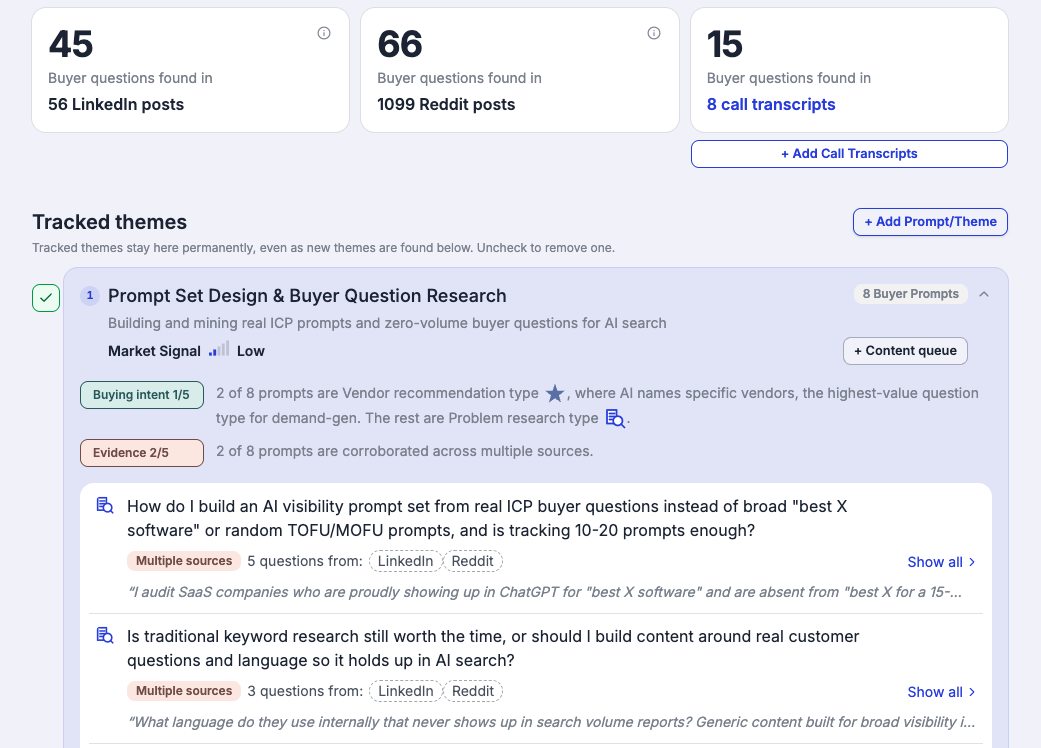
In this anonymized cybersecurity project, eight prompts sat beneath the Employee-Driven Vulnerability Remediation theme. Five represented Problem Research and three represented Vendor Recommendation. Seven were corroborated across multiple sources, including sales calls.
How buyer evidence becomes a trackable prompt
Buyer Evidence Record
|
Stage |
Example |
|
Buyer evidence |
Paraphrased from the source: patching is invasive and interrupts whatever the employee is doing. |
|
Inferred buyer question |
How can employees patch and reboot their devices without disrupting their workday? |
|
Trackable prompt |
How can a company get employees to reboot and patch their laptops without disrupting their workday, including appropriate timing, prompts and self-scheduled reboot windows? |
|
Classification |
Problem Research; implementation and employee-productivity tags |
|
Evidence |
Six related questions from call transcripts and Reddit, including multiple sales calls |
|
Why it belongs |
Represents a recurring implementation constraint that could affect product evaluation |
The evidence count is not AI prompt search volume. It shows the recurrence and cross-source corroboration of related needs in the buyer evidence reviewed.
8 Remove duplicates and keep meaningful variations
A prompt set should represent distinct buyer needs, not every sentence used to express them. These are probably duplicates:
- What is the best vulnerability-remediation tool?
- Which vulnerability-remediation tool is best?
Keep a variation when the change could plausibly alter at least one of the following:
- The buyer’s decision
- The eligible approaches or vendors
- The substantive answer or sources used
- The action your team would take after seeing the result
A variation may be meaningful when it introduces a different ICP, buyer role, technology stack, regulatory requirement, geography, use case or buying stage. AI-based semantic matching can identify likely duplicates, but commercial review is still necessary.
9 How many AI visibility prompts should you track
There is no universally correct number. Ten to twenty prompts can be enough for a directional benchmark covering one ICP, one product or use case and a defined set of buyer needs. They are unlikely to represent an entire category, multiple products or a complex enterprise buying journey.
Published recommendations vary. SE Ranking suggests beginning with approximately 20 to 40 prompts, while Profound suggests starting around 100. Aleyda Solís proposes ranges based on business complexity in her representative prompt library framework. These are operating recommendations, not universal scientific thresholds.
|
Prompt count |
A reasonable use |
What the number does not prove |
|
10 to 20 |
A narrow diagnostic for one ICP, use case and a few buyer needs |
Category-wide visibility or coverage of a complex buying journey |
|
50 |
Broader coverage for one product or several related personas or modules |
Representative market visibility if the prompts are redundant |
|
100 plus |
A modular program spanning several products, markets, personas or competitor situations |
Better insight if the additional prompts lack evidence or actionability |
A set is large enough for its defined scope when:
- Every high-priority buyer need has reasonable representation
- The intended mix of Problem Research and Vendor Recommendation prompts is present
- Important ICP, product and market differences are not averaged away
- The next best candidates mostly repeat needs already covered
- Every prompt can lead to a useful content, positioning or distribution decision
A practical stopping test is to review the next five to ten candidate prompts. If most introduce only a wording change, not a new need, constraint, persona or buying situation, the core set is probably large enough for now.
Prompt breadth and measurement frequency solve different problems. More prompts expand the buyer situations represented; repeated runs help account for variation in AI answers. Neither substitutes for the other.
10 Separate the stable benchmark from exploration
Changing the prompts constantly makes trends difficult to interpret. Never changing them causes the benchmark to miss new buyer concerns. Use two layers.
Core benchmark
The stable prompts used for recurring comparison. These should represent the highest-priority buyer needs and remain unchanged for a defined measurement period. When a core prompt changes, version the set and record what changed, why and when.
Exploratory set
A rotating group for emerging buyer questions, new products or competitors, uncertain variants and strategically useful synthetic hypotheses. Promote a prompt into the next core version when it fills an important coverage gap or repeatedly produces information the team can act on.
11 Exclude questions that do not improve the benchmark
A question does not belong in the core set simply because a real person said it. Exclude it or move it to exploration when it:
- Comes from someone outside the defined ICP
- Is unique to one account and has little wider strategic relevance
- Depends on confidential context
- Contains an obsolete product, competitor or regulatory premise
- Was primarily introduced by the salesperson rather than the buyer
- Duplicates a buyer need already represented
- Produces a result the company cannot interpret or act on
Treat recurrence carefully. Six comments by one participant do not equal six independent buyers, and social engagement does not necessarily indicate buying intent. Corroboration across independent buyers and sources strengthens the evidence, but it still does not establish population-level AI search demand.
Summary: Build the smallest defensible set not the longest list
A useful prompt set is a defensible sample of the buyer situations your company needs to understand and influence. It preserves the connection between the polished prompt and the original evidence, distinguishes explicit questions from inferred needs, retains answer-changing constraints and removes superficial repetition.
For every prompt, ask:
Which buyer does this represent, what are they trying to understand or decide, what evidence supports it, and what new coverage does it add?
If you can answer those questions, your AI visibility results are far more likely to reflect the buyer conversations that matter.
Get a free Buyer Question Audit
Rocksalt’s free Buyer Question Audit surfaces 20 company-specific prompts grounded in buyer discussions from sources such as LinkedIn and Reddit. Each question stays connected to its underlying evidence, so your team can see why it matters before using it for AI visibility measurement or content planning.
Request your free Buyer Question Audit to review the evidence, duplication and coverage gaps in your current prompt set.