.png?width=165&height=30&name=rocksalt-horizontal-rose-icon%20(1).png)
Your AI visibility dashboard might show that your brand appears in 25% of answers. Before deciding whether that is good or bad, ask: answers to which questions?
A brand can perform well on broad category questions and be absent when buyers ask about the specific problem it solves. It can appear frequently in answers to questions generated from its own website while missing objections that recur in sales conversations.
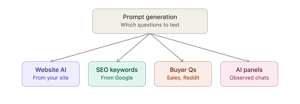
AEO tools build tracking prompts in four main ways: generating questions from your website, converting SEO keywords into prompts, extracting questions from buyer conversations, and selecting prompts observed in AI conversation panels. Some tools combine these methods. Each provides different evidence about what buyers need and what they actually ask AI.
Understanding those differences helps marketers evaluate a tool's suggested prompts, interpret its demand metrics, and decide where to invest in content. The four methods are a useful framework for assessing prompt sources; they are not an exhaustive list of every possible research input.
The four prompt sourcing methods at a glance:
| Prompt source | Evidence it provides | What it does not establish | Best use |
|---|---|---|---|
| 1. Website-based generation | Plausible questions based on your positioning | That buyers ask those questions | Initial coverage and hypotheses |
| 2. SEO keyword conversion | Search interest in an underlying topic | Demand for that prompt in AI assistants | Broad topic discovery |
| 3. Buyer conversations | An observed concern, sometimes with verified buyer context | Population-level AI search volume | Commercial relevance |
| 4. AI conversation panels | Questions observed among sampled AI users | Complete coverage of your target market | AI usage research and demand estimation |
What is a tracking prompt in AEO
A tracking prompt is a question or request submitted to an AI platform to measure its response, including whether it mentions your brand, recommends your product, or cites your content. AEO stands for answer engine optimization: improving how your company and expertise appear in answers from systems such as ChatGPT and Perplexity.
Consider this illustrative prompt:
Which project management tools work well for a 20-person creative agency that needs client approvals and time tracking?
The request includes an audience, an organization size, and two requirements. Those details help define a suitable recommendation. A broader question about the best project management software tests a different situation.
Prompts can also express research needs, desired outcomes, comparisons, or tasks:
- Research question: How can a creative agency reduce delays in client approvals?
- Outcome-based request: Help me manage client approvals without asking clients to create another account.
- Comparison: Compare these two project management tools for a small creative agency.
- Task: Create an evaluation checklist for software that handles approvals and time tracking.
These are illustrative examples, not observed customer queries. They show why a useful prompt source needs to capture buyer needs beyond questions beginning with “What is the best…”.
Visibility tools run selected prompts and analyze the answers. Peec, for example, documents running prompts daily across AI platforms and examining patterns over time. Peec documentation
A visibility percentage therefore needs a clear denominator. Unless a defensible sampling and weighting methodology supports a broader interpretation, it describes performance across the selected tests. It should not automatically be read as your share of all customer conversations in the market.
Prompt discovery and prompt volume are different things
Three activities often appear together in an AEO dashboard:
- Prompt discovery: choosing the questions and requests to track.
- Demand estimation: assessing how frequently people ask about those subjects.
- Visibility measurement: testing how AI answers the selected prompts.
Each activity can use different data. A tool might generate a prompt from your website, assign it a score based on Google search interest, and run it in ChatGPT. Another might select a question from an observed AI conversation and estimate demand for its wider topic.
Both can produce a dashboard row containing a prompt, a demand metric, and a visibility score. The evidence behind those rows differs.
A label such as “prompt volume” does not, by itself, tell you whether the metric is an observed count, an estimate, or a relative score. Ask where the prompt came from and what its demand metric measures.
Method 1: Website based AI prompt generation
This method starts with how your company describes itself. The system uses your website and brand information to infer products, audiences, category, and use cases. It then generates plausible questions, sometimes expanding them by persona or buying intent.
Peec documents using website content, industry context, and existing project prompts in its suggestion engine. It also supports topic-specific suggestions. Peec prompt setup documentation
Advantages
Website-informed generation is a practical starting point when little research is available. It can establish coverage across product areas and give a marketing team concrete suggestions to review.
It also supports strategic hypotheses. When entering a new market, you may have little observed demand data for the precise use case. You can still test whether AI understands the problem and identifies your company as a relevant option.
Generated prompts can serve as a consistent competitive benchmark. A deliberately chosen question can be useful as a test even without evidence that it was submitted by a real AI user.
Limitations
The questions inherit assumptions from your positioning. If your website emphasizes features while buyers care about implementation risk, its suggestions may reflect that imbalance.
We encountered this at Rocksalt. In an earlier version of the business, we described ourselves as an “expert-led inbound platform,” a category label we coined. A website-based tool suggested a prompt along the lines of “What are the best expert-led inbound platforms?” That reflected our own terminology. The suggestion itself provided no evidence that buyers used the category label.
Generation can also introduce unsupported specificity. A prompt mentioning a particular team size or budget may sound realistic even when those details were inferred rather than observed.
Best use: establishing initial coverage and testing explicit hypotheses. Review the audience assumptions before treating generated suggestions as evidence of buyer demand.
Method 2: SEO keywords converted into prompts
This method starts with search research. Keywords are grouped by topic and intent, then converted into conversational prompts using AI or templates. A term such as “agency project management software” might become questions about vendor selection, alternatives, or implementation.
Conductor describes using historical keyword data to generate synthetic prompts reflecting buyer personas and search intent. Its AI Search Performance FAQ also says it does not provide AI prompt search-volume data. Based on that documentation, it belongs in this category rather than being presented as an AI conversation-panel example. Conductor methodology
Advantages
Keyword research provides an external search-interest signal. It can identify established topics and broaden coverage beyond what appears on your website.
For teams with substantial SEO research, this is an efficient way to inform AEO work. Existing topic maps, competitive research, and content investments can help determine what to investigate.
Limitations
A keyword leaves context unresolved. Someone searching for “client approvals” might want software, a workflow template, or advice on handling a difficult customer. Turning that term into a vendor-selection prompt chooses one interpretation.
Search volume also measures activity in its source channel. Google defines average monthly searches around a keyword and close variants, using the selected geography, network, and date range. Those figures are rounded. Converting the keyword into a sentence does not turn its search volume into measured AI demand. Google Keyword Planner documentation
Volume-led prioritization can also overlook specialized questions. An integration requirement affecting a small number of valuable deals may deserve attention even when keyword tools report little demand.
Is traditional keyword research still useful for AEO
Yes. Use keyword research to understand search demand and discover topics. Use buyer conversations to identify the language, context, and requirements those keywords may omit.
For example, keyword research might identify interest in approval software, while sales conversations reveal that clients will not create accounts to use it. Together, those inputs suggest investigating approval workflows without client logins. The search data provides a topic signal; the conversations explain a requirement.
Best use: broad topic discovery and coordination between SEO and AEO. Keep search-derived metrics clearly labeled and validate any context added during prompt conversion.
Method 3: Questions discovered in buyer conversations
This approach starts with questions people ask in sales calls, customer channels, and relevant communities. It involves identifying those questions, assessing buying intent, and looking for evidence of demand within and across sources.
Rocksalt uses this approach to discover buyer questions from Reddit, LinkedIn, and a company's internal sources, such as sales calls. It evaluates their commercial relevance and the attention they receive, including whether similar concerns recur within a channel or appear across multiple sources. Rocksalt
This helps distinguish isolated comments from recurring needs while preserving specialized questions that may influence an important purchase decision. These signals indicate buyer interest; they are not measured AI search volume.
Advantages
Buyer conversations can explain why a question matters. In a sales call, you may know the person's role, the systems their company uses, the problem driving the evaluation, and the requirements that could prevent a purchase.
That context supports prioritization based on business relevance as well as recurrence. Conversations can also reveal language absent from your website: buyers may describe operational consequences rather than the product category your marketing team uses.
For specialized B2B markets, questions from identifiable target accounts can be valuable even when broader demand tools provide little usable signal.
Limitations
A question observed in a buyer conversation is evidence of a concern, but it does not establish that the same question was submitted to AI. It may have been; the original source alone cannot tell you.
The sample also has boundaries. Sales calls represent people who reached your pipeline. Customer channels may emphasize implementation. Community participants may not match your target buyers. A relevant Reddit or LinkedIn post therefore needs qualification before being treated as a buyer question.
Attention and recurrence need careful interpretation. Several comments from one person are different from the same concern raised by several independent accounts. Engagement may help identify an interesting discussion, but it does not establish purchasing intent.
Extraction also requires judgment. Rewriting “Can it connect to our existing system?” into a standalone prompt requires knowing what the speaker meant. Keep the original evidence and distinguish extracted wording from any edited or inferred prompt.
Best use: strengthening commercial relevance, particularly when the buyer's role, situation, and decision context can be verified.
Are you tracking the questions your buyers actually ask?
Method 4: Prompts selected from AI conversation panels
A panel is a sample of people whose interactions are observed over time. Vendors obtain AI interaction data, identify relevant conversations, and select prompts for tracking. They may also weight and extrapolate observations to estimate wider demand.
Profound describes licensing conversations from double-opt-in consumer panels and applying statistical adjustments. Its Prompt Research Reports retrieve relevant conversations, filter and deduplicate them, cluster related questions, and select representative prompts. Profound Prompt Volumes, Profound Prompt Research Reports
Advantages
Of these four methods, panel observations provide the most direct evidence that sampled prompts were submitted to AI assistants.
They can reveal questions outside your existing customer base and conversational behavior missing from keyword research. Where relevant observations are sufficient, they also provide a basis for estimating and comparing demand across topics.
Limitations
Panel size and target-market coverage are different questions. A large dataset can offer substantial consumer activity while containing limited evidence about a particular enterprise buying role or specialized workflow. Ask whether coverage of your audience can be demonstrated.
Modeled volume depends on matching, weighting, and extrapolation. A topic estimate may cover many different questions rather than repeated use of one sentence.
Scrunch illustrates why methodology matters. Its July 2026 Keyword Volume Estimator describes matching and filtering panel conversations, then scaling the signal into weekly US estimates. When observations are sparse, it discloses fallback to external search-demand signals and similarity to known topics. Even within a panel-based product, estimates can rest on different evidence. Scrunch methodology
Finally, replaying a representative prompt independently may omit the conversation history or personal context that shaped its original answer.
Best use: researching observed AI behavior and estimating broader demand, with sufficient coverage of the intended audience and transparent treatment of sparse data.
Which prompt sourcing method should marketers use
Choose the starting point that matches the decision you need to make.
- For a specialized B2B audience, prioritize verified buyer conversations when you have them. They can connect questions to real requirements and purchasing decisions.
- For evidence of what people submit to AI, prioritize relevant panel observations. Check coverage of your category and audience before relying on population estimates.
- Use keyword research to broaden topic coverage. It contributes search-interest evidence and connects existing SEO work to AEO planning.
- Use website-generated suggestions to test hypotheses and fill identified gaps. Treat inferred audiences and requirements as assumptions to review.
These are practical recommendations based on the methods' tradeoffs, not a proven universal ranking. A well-matched panel can be more useful than unqualified social discussion. A carefully designed synthetic prompt can be more useful than an authentic question unrelated to your market.
The categories can also overlap within one tool. Evaluate the evidence behind the particular prompt and metric rather than assuming every feature from a vendor uses the same source.
Five questions to ask your AEO vendor
Before accepting a suggested prompt list or demand score, ask:
- Where do the prompts come from? Can you distinguish observed AI requests, questions from other channels, and generated suggestions?
- What does the demand metric measure? Is it a sample count, modeled AI estimate, Google search metric, or relative score? Does it describe an exact prompt or a broader topic?
- Who does the evidence represent? What coverage exists for our audience, category, geography, and professional use cases?
- What happens when evidence is sparse? Are estimates withheld, marked uncertain, or inferred from other sources?
- Can we inspect the source and any transformation? Was the prompt edited, translated, clustered, or synthesized before being added to tracking?
The answers help you understand what the tool can support and where your own buyer knowledge needs to supplement it.
From prompt sources to a useful tracking set
Once you understand the sources, the next task is to select a set that represents the buyers and decisions you want to influence. That involves preserving meaningful context, distinguishing research from recommendation intent, and maintaining a benchmark you can compare over time.
The practical workflow deserves its own treatment. The companion article will cover how to build an AI visibility prompt set from real buyer conversations, including turning raw statements into prompts and judging whether your set has sufficient coverage.
For this article, the test is simple: can you explain where each tracked prompt came from, who it represents, and why it deserves attention?
If you can, your visibility dashboard becomes a more useful basis for decisions about content and where your company needs to appear. If you cannot, the first improvement to make is the evidence behind the questions being measured.