
In July, a post went out under Brian Chesky's name arguing that the hard part of building Airbnb was never the technology, it was trust. The internet quickly decided the post itself did not sound like him. Packy McCormick called the reaction an "antibody response" to executive AI slop, and communications strategist Lulu Cheng Meservey used it to make a broader point about outsourcing your voice: if you'll phone in your own ideas, what else are you phoning in? Chesky later said the account had been compromised.
The details matter, but the reaction matters more for anyone building an executive thought leadership program. People were not only judging the content. They were judging provenance. Did this thought come from the person whose name is on the post? Did someone senior actually care enough to shape it? If the answer feels like no, the post does not merely underperform. It can undermine the very trust it was meant to build.
That is why I think the CEO-led question starts in the wrong place most of the time. It usually gets framed as a brand strategy decision: should the CEO be more visible, should the company have a human face, should leadership show up on LinkedIn?
Those are real questions, but they come second.
First you have to assess whether this specific CEO can represent the company in public without the whole thing feeling forced.
Start with the person, not the strategy
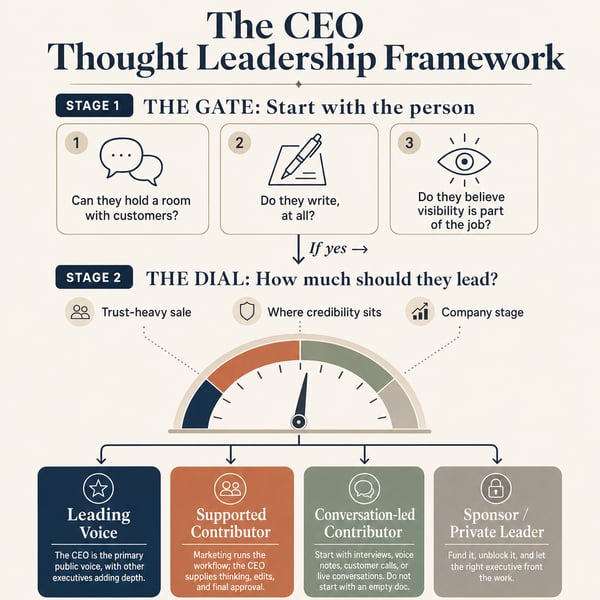
When evaluating whether a CEO should personally lead thought leadership, first evaluate three things before considering stage, category, or content calendar.
-
Can they hold a room with customers?
This is the core of being a good spokesperson and the most reliable signal available, because most companies have already watched it happen dozens of times. Do customers actually listen when they talk? Do they ask better questions afterward, or do they go quiet? And when the hard question comes, does the CEO handle it with ease or get visibly frustrated?
A CEO who bristles at a skeptical prospect will probably bristle at a skeptical commenter too, except now it happens in public and someone can screenshot it. -
Do they write, at all?
Most executives don't, but that should not automatically disqualify them. It mainly tells you what kind of operating model they need. A CEO with real judgment and no writing habit may need an interview-based process, voice notes between meetings, or a draft they edit rather than compose from scratch.
That support is fine. Often it is necessary. The line is crossed when marketing is not just helping them express the idea, but supplying the idea itself. -
Do they believe visibility is part of the job?
This is the test that predicts whether the program survives past month three. The mindset that works is not "I should build my personal brand." It is more like: buyers are forming opinions long before they talk to sales, and part of my job is to be useful and visible while that is happening.
If a CEO sees thought leadership as self-promotion, the content usually comes out stiff. If they see it as sharing what they are learning with the market, the whole process gets easier.
And if they do not buy that visibility is part of the job, don't persuade them into becoming the main public voice. They can sponsor the program, fund it, unblock it, and help choose the executives who should lead. But making a reluctant CEO the face of the company tends to create a slow, expensive bottleneck.
Then decide how much they should lead
Once the CEO passes this first gate, the question becomes degree of involvement.
Some CEOs should be the leading voice. Some should be a regular contributor with heavy support. Some should appear mostly through interviews, panels, comments, and customer conversations that marketing later turns into content.
Three factors matter most.
How trust-heavy is the buying decision
Long, expensive, consequential purchases are made largely before anyone contacts you. The 95/5 rule says only about 5% of your market is in-market at any moment; the other 95% are browsing, learning, and building a worldview about who is credible.
Those buyers may arrive at your site already holding an opinion. For that kind of sale, a CEO with a clear point of view can help shape the category conversation before the buyer is ready to buy. A transactional, feature-comparison sale needs less of this from the CEO personally.
Where the credibility actually sits
Technical chops matter, and so does having been the customer. If your CEO ran the function you sell into, they can answer buyer questions with a specificity nobody on the team can fake.
If the real authority sits with the CTO, VP of Customer Success, or a founder who is no longer CEO, the program should reflect that. Putting the CEO in front of topics where they have borrowed credibility usually reads that way.
Company stage
At early stage, the founder's story and the category story are often tangled together. The market wants to know why this company exists, why now, and why this team sees something others missed.
At scale, the CEO's authority is usually more about direction, change, and the company's view of the market. Product, technical, and customer questions may land better from the leaders who own those areas day to day.
What the recommendation usually looks like
In the parent piece on the CEO's role in executive thought leadership, we laid out four possible roles: leading voice, supported contributor, conversation-led contributor, and sponsor or private leader.
This decision framework is how to choose between them.
Leading voice: When the CEO passes the spokesperson, writing/support, and mindset tests, the sale is trust-heavy, and they are credible in the category. They become the primary public voice, with other executives adding depth.
Supported contributor: When the CEO has the right mindset and customer credibility, but almost no time. Marketing runs the workflow; the CEO supplies thinking, edits, and final approval.
Conversation-led contributor: When the CEO is strong with customers but weak or inconsistent on the blank page. Start with interviews, voice notes, customer calls, or live conversations. Do not start with an empty doc.
Sponsor or private leader: When the CEO does not want a public role, or credibility genuinely sits elsewhere. Fund it, unblock it, and let the right executive front the work.
The important part is that the model should match the human, not just the title.
Know what "leading" costs before you commit
CEO-led thought leadership is a real time commitment, although not necessarily in the way people assume.
Publishing is the smaller half. Our analysis of 6,753 posts from 39 top B2B voices on LinkedIn found average engagement tends to drop once posting frequency moves beyond one or two times per week, so 1-2x/week is usually enough. I would rather see a CEO publish one useful post a week for a year than commit to four posts a week and disappear by February.
The content mix should also stay balanced. A rough 30:50:20 mix works well: personal stories that show what drives the executive, industry commentary, and then company or product-specific content. Too much product and it becomes a company account with a face attached.
The larger commitment is participation. Commenting a few times a day in the conversations your buyers already read is often what makes the publishing work. That part is hard to delegate without it becoming obvious, because the value is not only distribution. It is judgment, taste, and presence.
There is also a practical reason this increasingly sits with people rather than brand accounts. Semrush found that individual members accounted for 59% of LinkedIn URLs cited in ChatGPT Search and Google AI Mode, and Meltwater put individual profiles at 75% of LinkedIn citations across six AI models. The internet, including AI search, is giving more weight to identifiable expertise than corporate messaging.
The failure mode is removing the executive from the work
Ghostwriting is not the problem by itself. Drafting help, interviews, editors, and AI can all be useful. For a CEO's schedule, some version of that support is usually required.
The problem is when the thinking gets outsourced along with the typing.
That is the part readers notice. It is also the part that makes executive content worth doing in the first place. If the CEO is going to lead, build a process around their actual judgment: how they talk to customers, what they believe about the market, where they have earned credibility, and how they can realistically stay involved.
If that process cannot exist, pick a different role. The CEO can still be essential to the program without being the person whose name appears on every post.
More resources on building the executive thought leadership muscle at your company.